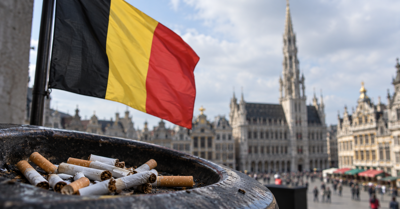
A new cigarette-pack survey commissioned by Belgium’s tobacco-industry federation found that 50.6 percent of packs collected in the country were either intended for foreign markets or counterfeit, the first time the combined share has topped half.
The survey, reported Sept. 21 by Tobacco Reporter, examined 2,800 discarded packs representing 59,320 cigarettes in 18 Belgian cities. WSPM Group conducted the collection for Cimabel, the Belgian-Luxembourg cigarette manufacturers’ federation. Foreign-market cigarettes accounted for 46 percent of the sample, while counterfeit products made up 4.6 percent.
The two categories should not be conflated; a foreign pack is not automatically an illicit pack. WSPM describes its empty-pack surveys as a way to identify non-domestic and counterfeit products, and notes that the non-domestic category can include cigarettes legally purchased and taxed in another country. The survey itself cannot determine how any particular foreign pack entered Belgium.
European Union rules also allow adults to carry tobacco bought in another member state for their own use without paying additional excise tax at home. Authorities may use quantities as evidence when deciding whether tobacco is for personal use; the EU guideline level is 800 cigarettes. Cigarettes brought from outside the EU are subject to much smaller duty-free allowances.
Even with that caveat, the trend is striking. Cimabel reported in March that 44.4 percent of cigarettes in its previous survey were foreign-market or counterfeit, up from 34.9 percent in the fourth quarter of 2024. The latest survey puts the combined figure another 6.2 percentage points higher. Leuven had the highest share at 61.7 percent, followed by Genk at 57.3 percent, and Charleroi at 54.8 percent.
Bulgaria was the largest identified source market in the new sample, accounting for 30 percent of cigarettes, compared with 15.7 percent a year earlier. Luxembourg represented 5.3 percent and Turkey 2.1 percent. Cimabel estimated the cigarettes represented a theoretical €2.6 billion in Belgian tax revenue. However, the survey cannot determine whether foreign cigarettes entered Belgium legally or through illicit trade.
Belgian authorities are also dealing with genuine illicit production and smuggling. The Federal Public Service Finance lists illegal cigarette factories dismantled in Houthulst in April and Thuin in June among its 2026 customs enforcement actions.
The pack survey therefore points to a rapidly growing non-Belgian cigarette market, but it does not prove that half of Belgian cigarette consumption is illicit. At minimum, it shows that a growing share of the cigarettes collected in the survey were not intended for the Belgian market

Learn how old you have to be to buy caffeine pouches, including federal and state age restrictions, retailer policies, and rules for minors.
Learn whether caffeine pouches are safe, including potential side effects, caffeine limits, oral health risks, and who should avoid them.
Because of declining cigarette sales, state governments in the U.S. and countries around the world are looking to vapor products as a new source of tax revenue.

A list of vaping product flavor bans and online sales bans in the United States, and sales and possession bans in other countries.