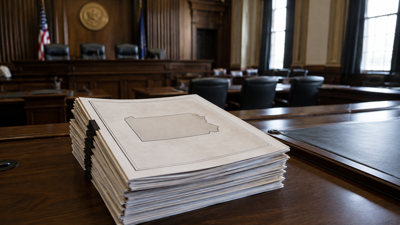
A federal judge has told Pennsylvania vape retailers challenging the state’s new product registry law to explain why two recent appeals court decisions do not sink their case.
The order puts the Pennsylvania lawsuit on a steeper path. Federal appeals courts covering North Carolina and Iowa have now rejected the industry’s central claim that state registries unlawfully interfere with federal tobacco law.
The Pennsylvania case was filed May 20 by companies operating dozens of Tobacco Hut stores, 101 Distributors LLC, and related businesses. The defendants are Pennsylvania Attorney General Dave Sunday and Revenue Secretary Patrick Browne. U.S. District Judge Julia Munley is presiding.
The plaintiffs are challenging Act 57 of 2025, which created a state directory for nicotine-containing e-cigarettes. Products generally qualify only if they have FDA marketing authorization, or if they meet limited conditions tied to a timely premarket tobacco application (PMTA).
The Pennsylvania law also gives retailers and wholesalers a limited period to remove unlisted products. After that period, the products are treated as contraband and can be seized and destroyed. State officials describe the directory as a sales regulation. The retailers say it effectively deputizes Pennsylvania to enforce federal premarket rules the FDA applies selectively.
That argument suffered two major blows on July 30.
The Fourth Circuit Court of Appeals upheld North Carolina’s registry law, ruling that the state was regulating which products could be sold within its borders, not enforcing the federal Food, Drug, and Cosmetic Act. The 2-1 decision affirmed a lower court’s refusal to block the law while the case continues.
The same day, the Eighth Circuit reversed an injunction against Iowa’s registry. That court also concluded the challengers were unlikely to prove that federal law preempted Iowa’s sales restrictions.
The Pennsylvania plaintiffs had relied partly on the earlier Iowa injunction. That victory is now gone, while the Fourth Circuit decision gives Pennsylvania another appellate ruling built around the same distinction: the FDA controls federal authorization, but states may still restrict retail sales.
Munley has not ruled on the merits. But asking the parties to brief both decisions makes the immediate problem clear. The retailers must show that Pennsylvania’s law does something materially different from the North Carolina and Iowa statutes, or persuade the court that both appeals courts got federal preemption wrong.
State registry laws turn the FDA’s badly managed premarket process into a blunt state prohibition. Whether that is good policy is separate from whether federal law allows it. For Pennsylvania’s retailers, the second question has suddenly become much harder to win.


Learn how old you have to be to buy caffeine pouches, including federal and state age restrictions, retailer policies, and rules for minors.
Learn whether caffeine pouches are safe, including potential side effects, caffeine limits, oral health risks, and who should avoid them.

Because of declining cigarette sales, state governments in the U.S. and countries around the world are looking to vapor products as a new source of tax revenue.

A list of vaping product flavor bans and online sales bans in the United States, and sales and possession bans in other countries.








![Image for Masked Thieves Pull Off Daring JUUL Heist [VIDEO]](https://media.vaping360.com/images/juul-robbery-04-800x533-04c28919d3.webp?imageType=Standard&MaxWidth=400&MaxHeight=400)