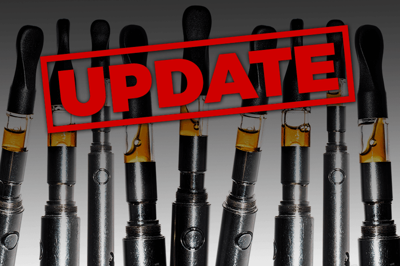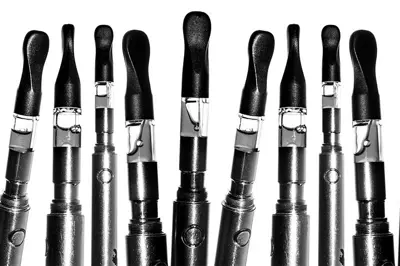
State and federal investigators have discovered that many of the illegal THC oil cartridges provided for testing by the victims of a mysterious lung condition contain a thick cutting agent called tocopherol acetate, or more commonly vitamin E acetate. New York State authorities are calling the substance a “key focus” of their investigation.
The story was first reported by the Washington Post, which referred to the substance as an oil. It technically isn’t an oil (though it is oil soluble), but can cause serious lung damage anyway. The possibility that tocopherol acetate could be responsible for the lung injuries was first raised by Leafly’s David Downs in an article published Aug. 30.
Tocopherol acetate is commonly used in skin creams, soaps, and other cosmetic products, but is not intended for inhalation. However, according to Leafly, it appears to be a primary ingredient in a thick diluent called Honey Cut that is popular with makers of black market hash oil. Honey Cut is mixed with the oil extracted from cannabis flower to dilute the product so more cartridges can be filled (and sold illegally).
The Honey Cut website, which has no address or contact information, was down Thursday evening.
The Post says the information was shared by federal investigators earlier this week in a phone briefing held with state officials, and the results aligned with testing done earlier by New York State health officials.
“We knew from earlier testing by New York that they had found vitamin E acetate, but to have FDA talk about it from their overall testing plan, that was the most remarkable thing that we heard,” an unnamed state official told the Post.
“At least one vitamin E acetate containing vape product has been linked to each patient who submitted a product for testing,” said a New York State Department of Health update issued Thursday. New York says that “vitamin E acetate is now a key focus of the Department's investigation of potential causes of vaping-associated pulmonary illnesses.” The state is currently investigating 34 cases.
"Our data are starting to agree with other sources of data that most of the products are non-traditional ... products," Acting FDA Commissioner Ned Sharpless told POLITICO. "It’s still too early to say definitively what is happening, but we’re very concerned."
One scientist from the University of Rochester (New York) told POLITICO that vitamin E acetate couldn’t have caused the lipoid pneumonia in patients he examined, since the substance is not an oil. Bryn Mawr College chemistry professor Michelle Francl told the Post that vitamin E acetate is “basically grease.” When it is heated and vaporized, it can decompose. And “now you’re breathing in who-knows-what,” she said. Then when it cools in the lungs, it returns to its original state and “it has now coated the inside of your lungs with that oil.”
Lipoid pneumonia aside, it is possible that the lung damage outbreak has multiple root causes. Some of the cases may have been caused by other kinds of contamination—fungicides or pesticides, for example. In a series of tweets Thursday, Dr. Konstantinos Farsalinos suggested we withhold judgement for now.
More than 200 cases are being investigated nationwide, and two people have died—one in Illinois and one in Oregon. The Oregon victim appears to have used a cannabis oil vape purchased from a dispensary, which seems to be the first time legal products have been involved.
What seems clear is that many of the victims are young and probably reluctant to report using illegal cannabis products. "Not everyone [in Illinois] reported using THC oil, but we can't say if that was because they were scared to acknowledge it or because they never used it," Illinois Department of Public Health director Dr. Ngozi Ezike told MedPage Today.
Also clear is that commercial nicotine vaping products are not responsible for the outbreak of lung injuries. But the FDA and CDC continue to warn against vaping any product, and refuse to make a direct statement implicating what appears the most likely cause. As we reported last week, federal officials persist in using language that confuses the public, rather than using the terms users of all vaping products understand.
Boston University public health professor Dr. Michael Siegel says that “in their zeal to demonize e-cigarettes, the CDC and other health agencies have put the lives of our nation's youth at risk. They should have issued a warning 11 days ago. During the past 11 days, how many youth continued to vape THC oils because of the failure of health agencies to accurately convey the known information about the potential causes of the outbreak?”
CDC is holding a press briefing this afternoon. If the agency doesn’t clearly describe the likely cause of the lung injuries, it will become clear—even to observers outside the vaping world—that federal public health officials are using this sad series of events to advance their decade-old effort to kill vaping.


CBG (cannabigerol) is the mother of all cannabinoids, including CBD and THC. Learn more about CBG flower, its effects, strains, and whether it can get you high.

Learn how old you have to be to buy caffeine pouches, including federal and state age restrictions, retailer policies, and rules for minors.
Learn whether caffeine pouches are safe, including potential side effects, caffeine limits, oral health risks, and who should avoid them.

Because of declining cigarette sales, state governments in the U.S. and countries around the world are looking to vapor products as a new source of tax revenue.